Mahound
The Satanic VersesMahound is a merchant turned prophet whose rise and death are recounted in dreams experienced by Gibreel Farishta. His story turns on the unstable authority of revelation: he founds a faith, faces a challenge that appears to compromise its central creed, repudiates the contested verses, and later governs a conquered city in the name of a single God. Yet the dreams leave open whether the words attributed to the divine come from beyond Mahound or from within his own human desires.
Identity and Mountain Solitude
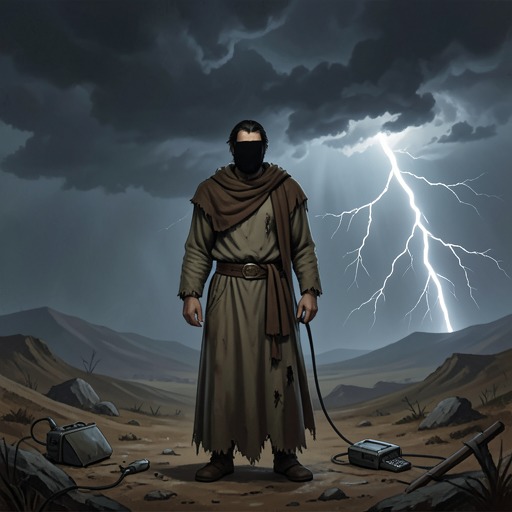
Mahound is introduced as a fit, broad-shouldered businessman who wears two lengths of plain cloth and climbs Mount Cone alone, sometimes remaining there for a month. His quick, cautious movements are linked to an orphan’s need to stay alert. The ascent separates him from the commercial city below and becomes the setting for his encounters with revelation. On the day of his birthday, while Jahilia shines beneath him, he faces what the narration calls a crisis of his life.
His name is itself part of the story’s concern with authority and identity. The name given to him in the vision carries a meaning associated with gratitude, but in Jahilia he refuses that name as well as the city’s mocking nickname for his mountain climbs. Instead, he adopts Mahound, a name imposed as an insult by foreigners. The narration presents this choice as a conversion of contempt into an emblem: the name is neither a neutral label nor merely a private preference, but part of the public struggle over who gets to define the prophet.
Below the mountain lies Jahilia, a city built from sand by the Shark tribe, whose people have settled at the meeting point of caravan routes. The city’s walls, roads, and merchant houses represent an attempt to make permanence out of a shifting substance. Water, however, threatens that achievement: it must be carried carefully, since spills can erode the sand-built streets and buildings. This is the commercial, precarious society in which Mahound’s new religion takes shape, and the contrast between its merchant order and his claim to divine authority follows him through the story.
Revelation and the Three Goddesses
Mahound’s followers report that he returns from a meeting with Abu Simbel carrying a proposal: Abu Simbel will tolerate and officially recognize the new faith if Mahound accepts Lat, Uzza, and Manat as worthy of worship. The offer also promises Mahound a place on Jahilia’s council. His followers expect him to refuse, and Salman the Persian warns that accepting would expose him to charges of fraud: Abu Simbel could claim that Mahound had tailored a revelation to secure political standing. Salman also argues that such a concession would undermine the creed that distinguishes the faithful.
Mahound says he has refused, but his account of receiving revelation makes the source of its authority difficult to settle. He describes listening to Gibreel Farishta as a process that is also a kind of asking, in which the messenger seems to come from the deepest part of his own heart. In Gibreel’s dream, the uncertainty becomes more radical: the archangel experiences himself as emerging from Mahound, joined to him by a cord, with neither clearly established as the dreamer of the other. The scene makes their connection intimate and inseparable without resolving whether Mahound receives, generates, or shares the words of revelation.
During this visionary episode, Mahound recalls miracles that he believes should have convinced the people of Jahilia. He describes Gibreel Farishta washing his heart with water from Zamzam, a night journey to Jerusalem that Mahound says he later described accurately, and an ascent during which the duty of prayer was reduced from forty prayers a day to five after he met Moses. Still, he says, people worship the old goddesses. At the moment when he asks what he should recite, the dream places his doubt and need alongside his prophetic authority.
At a gathering of poets, Mahound presents himself not as a poet but as the Messenger of a greater source. With Abu Simbel urging that a message from God must be heard by the world, Mahound begins reciting The Star while scribes write it down. Later, after withdrawing the verses associated with the three goddesses, he returns to Jahilia and announces their abrogation before the statues. He replaces them with verses that deny the goddesses’ authority. The sequence gives the episode a sharp reversal: the apparent accommodation is not retained as doctrine but publicly repudiated, while the dream’s earlier uncertainty about how revelation arises remains unresolved.
Law, Authority, and the Politics of Faith
In another dream, Salman the Persian describes the community of Submission at Yathrib as landless and poor, supporting itself for years through raids on wealthy camel trains. He portrays Mahound as a leader for whom the practical needs of the community could outweigh scruples about means. In Salman’s account, the revelations then become increasingly concerned with law, regulating ordinary conduct as well as religious life. He sees the detail of these rules as evidence of a striking resemblance between the supposedly heavenly lawgiver and Mahound the successful businessman, for whom organization and management come naturally.
Salman’s criticism is also directed at the rules governing marriage and women’s lives. He recalls that after the fighting, surviving men were instructed to marry widowed women so that they would not leave the faith; he also describes permission for a man to have as many as four marriages if he could afford them. He contrasts these rules with women’s greater independence at Yathrib, where, as he tells it, a husband lived among his wife’s people and a wife could end a marriage by turning the entrance of her tent away from him. Salman says that new restrictions followed, pressing women back into more submissive roles. These claims belong to his bitter account, delivered to Baal, and the narrative presents them through that speaker rather than as an unmediated record.
The conflict between public religious authority and private interests also appears in Salman’s account of Mahound’s marriages. He alleges that Mahound received a revelation granting divine support for taking additional wives, and recounts Ayesha’s skeptical response to the timing of that message. Baal initially listens as Salman condemns the sexual segregation associated with Submission, but then answers that Mahound’s marriages could also serve political alliances. Their exchange presents the same rules as both instruments of communal organization and a source of suspicion about the leader who announces them.
Return to Jahilia and the Question of Victory
After a quarter-century of exile, Mahound returns to Jahilia with his power extending around the city and its caravan trade diminished. The contrast with his earlier arrival is pointed: the sand-built town has hardened into a poorer, more ordinary place, while Mahound returns in a position of strength. Baal recognizes the change through a drop of blood-colored liquid at the statue of Al-Lat and understands that the Prophet is on his way back. The city’s transformation mirrors the altered balance between its old religious and commercial order and the movement that once seemed vulnerable there.
Abu Simbel surrenders Jahilia to Mahound and embraces the new faith. Hind, Abu Simbel’s wife, responds with anger, appearing before a crowd and demanding that the citizens punish her husband for giving up the city. Abu Simbel instead tells them that Mahound has promised safety to everyone who enters his house, and invites the people to bring their families inside. The offer of protection is immediately tested by Hind’s objection that one house cannot shelter an entire city. The scene makes the surrender more than a transfer of power: it exposes the competing claims of personal survival, public responsibility, and the terms of Mahound’s victory.
The conquest is followed by the destruction of Jahilia’s idols. Khalid first enters the temple of Uzza and returns believing that the motionless statue proves it is only stone. Mahound sends him back, and Khalid reports a second encounter in which a terrifying figure invokes the three goddesses before he kills her. Mahound then declares that the army may enter Jahilia. The story’s sequence joins military action to a test of religious meaning: the idol’s destruction alone is not enough for Mahound, and the report of a further encounter completes the authorization in his eyes. The three hundred and sixty idols in the House of the Black Stone are then broken.
Mahound’s conduct after the victory complicates the image of conquest. Salman the Persian is brought before him, accused of having set his own words against the words of God, and initially faces a death sentence. Salman begs for his life and offers to reveal the location of Mahound’s enemies. Bilal intercedes, and Mahound permits Salman to live. He also spares Hind; the narration emphasizes that no old enemy is dragged from a house to be killed. The episode frames clemency as Mahound’s answer to the question of what happens after victory, even as Baal’s name continues to occupy his thoughts and Khalid offers to find him.
Baal, Death, and the Dream’s Uncertainty
Baal remains a living challenge to Mahound’s authority. In Jahilia, he takes refuge at The Curtain, where the women there assume the identities of Mahound’s wives and Baal becomes their husband within this role-playing arrangement. The women eventually ask him to act more like the husband they are imitating, but Baal refuses to change his name. When Mahound returns, Baal speaks publicly about the arrangement. His account makes the audience laugh, and Mahound interprets the laughter as a renewal of the earlier mockery of the Recitation and an insult to his household. Baal is sentenced to death. The contrast between the crowd’s laughter and Mahound’s judgment makes the episode a confrontation over whether poetic ridicule can escape the authority of the new order.
The dream of Mahound’s death brings his story to a quieter close. As he lies ill, Hind prepares a banquet as an act of revenge, while Ayesha remains with him. In the vision, Mahound is offered a choice between this world and the next. Hind tells him that her revenge has been accomplished; Mahound responds by expressing gratitude to Al-Lat. The final exchange between Ayesha and the gathered followers distinguishes grief for the Messenger from rejoicing in God’s continued life. Mahound dies, and Gibreel Farishta’s dream ends.
Mahound’s narrative significance rests on the tension between his different forms of authority: merchant, solitary climber, recipient of revelation, lawgiver, conqueror, and leader capable of clemency. The story grants him decisive power over Jahilia while repeatedly placing that power beside human interests, political calculation, and an uncertain relation to Gibreel Farishta. Because these episodes arrive as dreams, and some of their histories are relayed by figures such as Salman the Persian, the narrative does not settle their claims into straightforward biography. Mahound’s ascent and fall instead dramatize the difficulty of separating the voice of revelation from the human voices that interpret, transmit, and wield it.